
If you’ve ever clicked a button on a website and something happened right away — like a menu opening, a form checking your input, or a photo gallery sliding — chances are JavaScript was at work.
But what exactly is JavaScript, and why does it matter so much in the world of web development? Let’s break it down step by step.
🟡 A Language for the Web (and Beyond)
JavaScript is a programming language — a way to give instructions to a computer. It started as a language for browsers, but today it’s everywhere:
- On the frontend (what you see in the browser).
- On the backend (servers, using Node.js).
- In mobile apps, desktop apps, and even IoT devices.
🖥️ The Languages Browsers Understand
When you open a website, your browser (like Chrome, Safari, or Firefox) only understands three core languages:
- HTML → structures the page (headings, text, images, links).
- CSS → styles the page (colors, fonts, layouts).
- JavaScript → makes the page interactive (buttons, animations, instant updates).
Everything else you might hear about — like Python, Java, or PHP — runs on servers and then sends results to the browser. But HTML, CSS, and JavaScript run directly inside the browser itself.
👉 That’s why JavaScript is unique — it’s the only programming language that browsers natively understand.
🕰️ A Quick History of JavaScript
JavaScript was created in 1995 by Brendan Eich at Netscape. Fun fact: the first version was built in just 10 days!
At that time, the web was static — websites were like digital newspapers. Netscape wanted a way to make web pages interactive, and JavaScript was born.
Since then:
- It became an official standard (so all browsers use it the same way).
- New versions (ES6, ES7, etc.) added modern features.
- With the launch of Node.js in 2009, JavaScript started running on servers too.
Today, JavaScript is one of the most popular programming languages in the world, powering apps from Facebook to Netflix.
🟡 Why Learn JavaScript?
JavaScript is often the first language beginners learn, and for good reason:
- It’s everywhere — websites, servers, mobile apps, and more.
- It’s beginner-friendly — simpler to start with than many other languages.
- It unlocks creativity — you can see results instantly in your browser.
🟡 Your First JavaScript Program
Here’s the simplest program you can write:
console.log("Hello, world!");
When you run this, your computer prints:
Hello, world!
👉 Where to run this code:
You don’t need any special setup. Just open your browser, right-click anywhere, choose Inspect, go to the Console tab, and type the code there. You’ll see the result immediately!
(Later, when you learn Node.js, you’ll be able to run JavaScript directly on your computer too.)
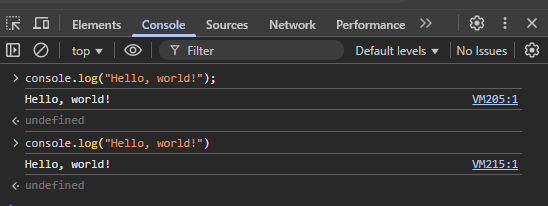
🔎 Note on semicolons:
You might notice the line ends with a semicolon (;). In JavaScript, semicolons are technically optional because the language will usually insert them for you.
However, it’s a good habit for beginners to always include them — it keeps your code clear and avoids rare errors.
📜 JavaScript, ECMAScript, and Friends
As you explore more, you might hear related terms:
- ECMAScript (ES): The official rulebook for JavaScript. New editions (ES6, ES7…) add new features.
- TypeScript: A version of JavaScript with extra features like types. It makes large projects safer and easier to manage, and many companies use it.
- Other variants exist, but today JavaScript + TypeScript are what really matter.
👉 For beginners, just focus on plain JavaScript. Everything else will make sense later.
🟡 Where to Go From Here
Now that you know what JavaScript is, next we can learn its building blocks:
- Variables (to store information)
- Functions (to organize code)
- Arrays and Objects (to manage collections of data)
With these basics, you’ll have the foundation needed to build interactive websites — and eventually explore powerful tools like Node.js.
✨ In short: JavaScript is the language that powers the web — and with Node.js, it powers much more. Learning it opens the door to countless opportunities in modern programming.